Wednesday, July 6, 2016

The Plumb Family


View atop St Paul's Cathedral, London
In my line of work, I find it demeaning when potential clients shop around for lawyers who can give them the best discount on their legal fees for debt recovery work relating to their business, real property transactions and probate matters although such matters appear routine and straightforward until and unless they become contested. It is even more demoralizing to see that many lawyers compete by charging pittance for their work with the hope that they will get more work to cover their cost of running their law office. Everyone loves a good bargain and discounts attract clientele and customers. Many of us purchase things that we otherwise would not have spent money on and we have bought them because we feel that they are good buys. It is consumerism. I once thought professional services would be spared and I could not be more wrong. Good deals are sought after and value for money is the catch phrase if you want to sell something to the populace.

We live in a commercial world thus money plays a significant role in keeping us afloat. Simple and frugal living is a virtue as most of us have far from expansive  spending power. Due to rising cost of living, it is indeed a constant balancing act between our earnings and the lifestyle we want to upkeep.


I have a distant relative who has managed his finances well and retired early; he lives a comfortable and reasonably carefree lifestyle. His wife is a very capable woman who has a successful career and they have two sons and a daughter who are doctors training  to be specialists in their respective fields. They live the picture of a success story of first generation migrants in a foreign country. We keep in touch every now and then. Recently they were in town and they invited my family out for a meal with them. We got along fine and had a good laugh about things. My relative comes from a family of four children and most of them are doing seemingly well financially in their past retirement age. What surprises me was after my dinner, the other siblings of my relative regarded the kindliness showered by him and his wife carried some ulterior motive which baffles me. Like  many families, the siblings do not get on as well as they should be. Their dad, in his nineties, is one good example of a man of wealth who leads a frugal and simple life. He will definitely leave behind a sizeable inheritance for his children who probably feel the sense of entitlement even though they do not necessarily need the money. It would be a windfall. Every family, dysfunctional or not, has its problems and often it is about the money whether due to its presence or its absence.

In The Nest, the debut novel written by Cynthia D'Aprix Sweeney, the Plumb siblings have been waiting for Melody, the youngest sibling to turn 40 years of age so they could claim their share in the trust fund set up by their late father. The joint trust fund is meant  to be a modest mid-life supplement set up by their deceased father, Leonard Plumb Sr. The Plumb siblings have watched the Nest’s value soar along with the stock market and have been counting on the money to solve their multiple self-inflicted problems.

Leonard is not materialistic and he has built a thriving business based on absorbency. During his lifetime, he had chanced upon a team working with a new substance: synthetic polymers that could absorb three hundred times more liquid than conventional organic absorbents like paper and cotton. The super absorbers have many applications that extended to consumer products e.g. better feminine hygiene products  and disposable diapers.  He was an extremely frugal man as he tried to fix everything that needed repair. At home various items were marked with his handwritten notes . Examples : “ Use with Care !” for  the hair dryer that could only be held with a mittened pot holder because the cracked handle overheated too quickly,"Use Sparingly!" for leaky coffeemakers , "Use with Caution” for bikes with no brakes etc. As a result of his frugality, business acumen and conservative investment in blue chip stocks, Leonard managed to set aside some funds to provide a modest safety net for his children’s future, 'nothing so vast as to be truly significant' but 'just a little something to 'pad their retirement a bit , maybe help fund a college tuition or two'. As he wanted his children to be financially independent and to value hard work, he left strict instruction that the money would be tied up until his youngest child, Melody turned forty. He didn’t believe in paying strangers to manage his money, he enlisted his second cousin George Plumb, who was also an attorney to manage it. The only person who could access the funds early was his wife , Francie who remarried after his passing. She abided by his wishes to the letter until one of their sons met with an accident that involved a waitress at his cousin’s wedding. Leo was the most charming amongst all the siblings but he was the also the unreliable one. After  Leo’s accident, the family’s trust fund depleted such that  the Plumb siblings’ hope for the trust fund to help them with their financial issues dashed.

One of Leonard’s son , Jack Plumb is gay and  is married to Walker , an attorney who is smart and sensible. One day, Walker decides to get the Plumbs together in one room and try to make a tiny inroad into facilitating some kind of agreement about the infernal sum of money they still insisted on calling The Nest. Walker felt that Jack and his siblings were infantile, ‘he couldn’t fathom how a group of adults could use that term in apparent earnestness and never even casually contemplate the twisted metaphor of the thing, and how it related to their dysfunctional behavior as individuals and a a group. Just one of many things about the Plumb family he’d stopped trying to understand.’ 

The occasion was meant to celebrate Melody’s 40th birthday but as events unfolded, the party did not proceed as planned by Walker.

To me except for Bea Plumb, a once-promising writer , the siblings are not likeable characters. The interesting characters are those who have gotten themselves involved with the Plumb family.

The Nest is a story well told that shows us what money does to relationships and how our ambitions change over the course of time and it is a story about the power of family, the possibilities of friendship and love that rise above all as the siblings grapple with the realities and the choices they have made in their own lives. 

Sunset ,San Sebastien, July  2015


Tuesday, June 21, 2016

Entropy


I like a living space with contemporary and Spartan design but I know it will be difficult to keep such a place neat and tidy. My study room (formerly my daughters’ study room) is chaotic as there are stacks of books everywhere. A couple of weeks ago, there was a book sale and my family ended up buying more than a dozen books and they are now occupying space on my writing desk which was formerly my daughters’ writing desk when they were in school.

I have read about espresso book machine that print books on demand. How does it feel to walk into a book shop where you do not see books?  It is always a pleasure to meet book lovers as only book lovers know how it feels to hold a printed book and run their fingers over the pages as their eyes devour the writings.

During the recent book sale, I picked up the debut novel written by Will Wiles. Care of Wooden Floors is not a manual for caring of the wooden floors but a satire. As the description on the back cover aptly describes : ‘Care of Wooden Floors is about loneliness, friendship and the quest for, and struggle against, perfection. And it is , a little , about how to take care of wooden floors.’

The  unnamed protagonist, a freelance copywriter from London has been asked by Oskar, an old university friend to housesit his nice and pristine flat which is located in an unspecified part of Eastern Europe. The story is narrated by the unnamed protagonist in first person’s voice. Oskar is a minimalist composer who has to be away in Los Angeles to deal with his divorce. Oskar is a “borderline obsessive- compulsive” and despite having left very specific instructions on numerous notes throughout the flat to instruct the narrator about how to care about his cats and the expensive French oak floors, the narrator spills red wine on the floor and in trying to salvage the damage, the result is disastrous. From the beginning, you could smell something catastrophic particularly after reading about Oskar’s four A 4 pages long of instructions, one of them being ‘DO NOT put any drinks on them without  a coaster’ and  ‘ If anything should spill, you MUST wipe it up AT ONCE!!! So that it does not stain the wood. Be VERY CAREFUL. But if there is an accident (!) then there is a book on the architecture shelf that might help you . CALL ME if something happens.’

On Day Two, the narrator discovers a wine stain.
‘ I stopped. A drop of wine or two must have made their way to the base of the glass on one of my many refills. There was no coater beneath it. ( In my mind’s eye, Oskar winced. ) A 45- degree arc of read wine marked his precious floor, a livid surgical scar on pale fresh.’

The narrator immediately runs a dish cloth under the tap starts to  rub and scrubbing
 ‘There was still a mark. The slightest, faintest curved, blush, hardly noticeable in the natural grain of the wood. A birthmark awaiting its final laser treatment. But now my eye was unstoppably drawn to it – as if was as large, as black, as inescapable as the sofa.’

Over a period of eight days, the narrator proves to be an unreliable house-sitter. On day five, one of Oskar’s cats has been killed by the piano lid that was left open when the narrator had forgotten to close the top of the piano after having it propped up. He recalled that he had disobeyed Oskar’s note “ Please do NOT play with the piano” and as he fiddled with piano keys, hit a key, the phone rang. The phone call was from Oskar and after he hanged up, he completely forgot about the piano.

‘ The piano lid had dropped onto the cat, breaking its spine. So the piano had been open – I had left it open. The cat must have jumped up and dislodged the strut that held up the lid;may be it had stood on the edge, rubbing against the strut. The caricature drunk supporting himself on a lamp post . Slam. Had it been quick? There was no blood on the outside, no scratch marks. The body would have to be moved, I thought. I made a mental edit :I would have to move the body. It could hardly be left like this . But where? ’

The humour is wry and  dark. The writing is contemporary and stylish. Will Wiles writes about the scene after the protagonist spent a late night with Oskar’s colleague:
‘DAY FIVE
White noise. Indistinct sound, beneath hearing, the growl and whoosh of blood forcing through tight passages. A two-part beat, the slave-driver’s padded drumsticks rising and falling as an exhausted muscle trireme heaves across a treacle ocean. A heart, pumping hot, thick goo in place of blood. Cells striving and dying. The electricity of the brain whining like an insectocutor. A cascade of neural sparks, an ascending, crackling chain reaction, synapses firing. Sensation – the sensation of no sensation. Then, awareness.’

Sometimes we should leave a tiny oversight alone.  I find that the more we fuss about something and strive for perfection, it turns entropy. Care of Wooden Floors is about the absurd, a dark and funny story. It tells about how we lose sight of what should matter and what should not.


Thursday, June 16, 2016

Wabi-sabi


The randomness of fate spares none of us. All we can endeavour is not to make life more complicated than it is. The world is fragmented so are its inhabitants. As we carry on doing the things that we do in the hope that we have a good life, we experience happiness, sadness, boredom, excitement, anger, disappointments and anxiety. When we are confronted with conflicts and quandaries, we believe that we have to be true to ourselves when we make our decisions. To me, life is about continuing education and finding some kind of balance and synergy with the universe and there is no perfect recipe.

In their book entitled “The Path”,  Professor Michael Puett and Christine Gross- Loh discuss the work of  ancient Chinese philosophers and explain the wisdom imparted from the mid-first millennium B.C. thinkers such as  Confucius, Mencius, Laozi and Zhuangzi who make us rethink how  we think and what we have come to believe. The authors begin the book with chapters entitled  the Age of Complacency and the Age of Philosophy and discuss various Chinese philosophers under different headings : relationships, influence, vitality , spontaneity and humanity.

On Relationships, the authors discuss Confucius and As-if Rituals. Confucius taught that we can cultivate goodness through rituals and that we should concentrate on what we can do in the here and now to bring out the best in those around us. The authors explain that for Confucius, ancestor worship could better relationship between the deceased and the living that had been imperfect and fraught thus the as-if ritual was essential because of what it did for the people performing it. The ritual also changed the feelings of the living toward one another as family members gathered to perform the ritual.

The authors write,
‘Of course , the ritual always ends. Family members walk out of the ritual space, and the moment they do, they are in the messy world again. Over time the fragile peace falls apart once more. Siblings squabble, cousins rebel, the father and son are still at odds with each other. That is why families returned to the ritual repeatedly. The fragile peace might crumble once they left the temple, but gradually, by doing the rituals again and again and re-creating these healthier connections, the improved relationships among the family members would begin to manifest more in daily life.’

The authors explain that “break” with reality is the key for allowing the participant to begin to work on their relationships. The authors make analogy to the as-if rituals that existed in European society where up to three centuries ago, social relations were still defined entirely by hereditary hierarchy. However  as markets began to develop in the cities, rituals develop between buyers and sellers as if they were equal hence the “please” and “thank you” exchange in market places where the participants could experience a semblance of equality.

 The authors write, ‘If we were always “true” to ourselves and behaved accordingly, we would be stuck in old behaviours, never forgiving, and limiting our potential to transform.’
‘Change doesn’t happen until people alter their behaviour, and they don’t alter their behaviour unless they start with the small.’

‘Yet it is only once we conduct our lives with goodness that we gain a sense of when to employ rituals and how to alter them. This may sound circular, and it is. This very circularity is part of the profundity of his thought. There is no ethical or moral framework that transcends context and the complexity of human life. All we have is the messy world within which to work and better ourselves. These ordinary as-if rituals are the means by which we imagine new realities and over time construct new worlds. Our lives begin in the everyday and stay in the everyday. Only in the everyday can we begin to create truly great worlds.’

Confucius, when asked to describe himself, he replied:
 "He is a person who is so impassioned that he forgets to eat, who is so joyous that he forgets to be worried, and who grows into old age without noticing time passing by."

Just as the world is fragmented, we are too. We could think of ourselves as complex arrays of emotions, dispositions, desires, and traits that often pull us in different and contradictory ways. A Confucian approach is for us to make a conscious effort to break away from our usual emotional behaviour if we want to become better human beings and have better relationships.

On Decisions, the authors talk about Mencius ‘who would argue that the very things we believe to be true when we plan out our lives are also the things that, ironically, limit us.  How we live and make decisions comes down to whether we believe we live in a world that is coherent and stable or one that is – as Mencius taught –unpredictable and capricious.

‘Mencius believed, the world is fragmented, in perpetual disorder, and in need of constant work. And it is only when we understand that nothing is stable that we can make decisions and live our lives in the most expansive way.’

Mencius disagreed with Mozi on the belief that Heaven was a moral deity who laid out clear guidelines of right and wrong and humans would be rewarded if they did if not, they would be punished.
 “ Mencius found Mozi’s ideas would not result in a world of social harmony and universal caring. Instead , they would result in a near Pavlovian world where people had been conditioned to what they had to in order to gain rewards and avoid punishment. It would be a world , in fact ,in which people had been trained to think of their actions purely in terms of self- interest :What do I do to get what I want ? ‘

Mencius believed that the world is not coherent but capricious nonetheless we all have the potential to be good . To Mencius, ‘what set good people apart from others was that they had not lost touch with their emotional side, instead, they held on to and assiduously cultivated their emotional responses. And that was how they knew the right thing to do –the right decision to make – in any situation.’

‘It’s a  very different vision from asking grand questions such as “Who am I?” and “How should I plan out my life?” Instead, we work constantly to alter things at a small, daily level and if we’re successful, we can build tremendous communities around us in which people can flourish. And even then , we continue to work. Our work – of bettering oneself and others to produce a better world – is never over.’

“In Mencius’ world, ming prevails. Ming has been translated variously as Heaven’s commands, fate, or destiny. But for Mencius, it was a term for the contingency of life : the events, good and bad, that happen outside our control. Ming explains that windfalls ( such as a job opening) and tragedies (such as a death) happen no matter what we have planned or intended.”

Mencius spoke of the heart-mind to guide us. 'Good decisions are made when mind and heart are integrated.'We must learn to work with whatever befalls us. ‘As Mencius tells us, “ One who really understands his ming does not stand beneath a falling wall. One who dies after fulfilling his way has corrected his destiny.”'

On Influence, the authors refer to the recipe for influence in Chinese philosophical texts such as the Laozi, also known as the Dao de jing. It derives from appreciating the power of seeing weakness, understanding the pitfalls of differentiation, and seeing the world as interrelated. Rather than think that power comes from strength prevailing over strength, we can understand that true power comes from understanding the connections between disparate things, situations, and people. Laozi in Chinese simply means “old master”.  We don’t know when Laozi lived and there is debate over whether Laozi was the name of a real person. 

The Way is about seeing the world as interconnected. The more we see that world as interconnected, the closer we come to the Way.

The Laozi ‘is not telling us that we should strive to be accepting and tranquil. It teaches a very different notion: that the Way is something we can actively generate ourselves, in the here and now. We each have the potential to become effective and influential in transforming the worlds in which we live. We can re-create the Way.

For Laozi, the Way is the original, ineffable, undifferentiated state that precedes everything. It is :

a thing inchoate and complete, 

born before Heaven and earth.

 It is that from which everything in the cosmos emerges and to which everything in the cosmos returns.

And it exists on many levels. On an earthly level, the Way is akin to the ground.‘

The authors write,

‘ On a more cosmic level, the Way is akin to what modern physicists would say existed before the Big Bang, before the stars and galaxies emerged and the cosmos became differentiated. It was after the Big Bang that the cosmos became a series of differentiated elements governed by law of space, time , and causality.‘

In  the chapter on Vitality : The Inward Training and Being like a Spirit, the authors write about how we can learn to refine our senses in order to see things clearly.
‘Music, poetry, art , and literature are composed of discrete elements such as words, notes, sounds, rhythms, and colours. The more we immerse ourselves in them, the more we understand how discrete things resonate with one another, just as qi resonates with qi. They represent how qi relates constantly to all of the other forms of qi around it – for better or for worse.’

In the chapter on spontaneity, the authors write about Zhuangzi and the famous story of the butterfly. ‘What if you were not merely a human being but were actually a butterfly dreaming you are a human being? What if we could transcend our humanity and know what it means to see the world from all perspectives, we could experience life more fully and spontaneously.’ According to the authors, for Zhuangzi, the Way was about embracing absolutely everything in its constant flux and transformation. ‘Zhuangzi referred to the terms yin and yang, or darkness and light, softness and hardness, weakness and strength. The Way , he argued , is a process of constant interactions between these two elements that seem to stand in opposition but actually complement each other.’

‘Grass grows, when it dies, it decomposes, and its  qi is channeled into other things. Worms and bugs in the grass are eaten by birds, which in turns are eaten by larger birds or animals. These larger beasts, too, die over time, decay, become part of the earth, and transform into soil, grass, and other elements. Everything slowly becomes everything else in a cycle of endless change and transformation.’

But don’t be mistaken, spontaneity for Zhuangzi isn’t about doing whatever we want whenever we want. The authors explain,
‘True spontaneity requires us to alter how we think and act in the world, to open ourselves up to endless flux and transformation all the time.’

Zhuangzi urge us to open ourselves up to the world, to the Muses in turn ‘to a river of creativity’. Zhuangzi’s trained spontaneity means thinking differently and shifting our perspectives and 'freeing ourselves of a conscious mind that is by definition restricted to a single self' as' our mind often gets in our way, causing us to battle against rather than flow with the Way.' 

On Humanity : the authors write about Xunzi who famously likened human nature to a crooked piece of wood, one that had to be straightened forcibly from the outside. Xunzi who lived about two hundred fifty years after Confucius synthesized the works of all the thinkers who came before him as he would likely  remind us ,’each of our personas is constructed. Even when we think we’re being natural and “real,” being like that is a choice, and thus it is a kind of artifice too.’

The authors write,'Xunzi wanted us to harness the mind to improve upon our natural selves and our natural world and become the best human beings we can be.'

In ‘The Path’, Professor Michael and Dr Loh show how the teachings of the ancient Chinese philosophers can offer possibilities for thinking afresh about ourselves and about our future. In its foreword, the authors said, ‘none of these ideas are about ‘embracing yourself’ , ‘finding yourself,” or following a set of instructions to reach a clear goal  In fact, they are the very antithesis of that sort of thinking .’

 In a nutshell, the book tells us that the Chinese thinkers would be skeptical of the existence of a true self as they understood that we are multifaceted, messy selves and we form our personalities through everything we do and our interaction with things and others. We must be aware of our complexity and learn how to work with it through self- cultivation. The Path reminds us that we can achieve emotional stability and become better people by cultivating balance and alignment in our everyday ordinary living. In its last chapter entitled ‘ the Age of Possibility’, the authors write :

‘The process of building a better world never ends because our attempts to build better relationships are never finished. But as we learn how to better our relationships, we will learn how to alter situations and thereby create infinite numbers of new worlds. We will open ourselves up to the possibilities in these philosophical ideas that point the way to a good life.’

‘ If the world is fragmented, then it gives us every opportunity to construct things anew. It begins with the smallest things in our daily lives, from which we change everything. If we begin there, then everything is up to us.’

The Path is a commendable read. clickhere
also click 

Sunday, May 22, 2016

What Now?


Boy meets girl, girl meets boy, they get married. Their child is about to leave home for college. He is looking forward to them growing old together, him and her, growing old and dying together. His wife, Connie replies, “ Douglas , who in their right mind would look forward to that ?” 

In Us, David Nicholls,  once again cleverly tells a contemporary love story about two protagonists that has lasted more than two decades, how they got together and the dynamics between them.  Just like the couple in One Day, the much acclaimed novel by Nicholls, the couple in Us is put to the test. In One Day the mismatch was between Emma, a serious minded woman and Dexter, a self-indulgent man. Their friendship spanned over twenty years as they kept in touch with one another by meeting  up once a year. In Us, Douglas Timothy Petersen, a 54-year-old industrial biochemist, a disciplined  man is married to 52-year-old Connie whom Douglas loves very much. Connie and Douglas is another unlikely match. While it appears unlikely that she who loves art and culture and has done a lot of sex and drugs would have been attracted to Douglas who knows nothing about art and a scientist who is consumed by  his work.The story is told from the perspectives of Douglas who is very much troubled when Connie tells him that she thinks their marriage has run its course and she thinks she wants to leave him.

Us is a story about the relationships between a man and his wife and also between a man and his eighteen year old son, Albie. Before their son goes to college, Connie suggests a grand tour of Europe to prepare their son for the adult world and he hopes that the family trip will bring them closer. In his desperate attempts to get close to  his son and make Connie fall in love with him all over again, things keep going wrong and he ends himself in odd and embarrassing situations which are hilarious and incredibly silly .

Like many of us , Douglas thinks he is doing  things differently from his parents and he wants to be a better parent than his father.

‘Because throughout my childhood and teenage years I had been compiling a list of banal and irritating remarks that I swore  I would never, ever make when I was a parent. All children make this list, and all lists are unique, though no doubt there is considerable overlap. Don’t touch that , it’s dirty! Write your thank-you letters, or no more presents! How can you waste food when people are starving?   All through Albie’s childhood, out they rumbled. No more biscuits, you’ll spoil your appetite ! Tidy your room ! It is WAY past your bedtime? Do NOT come downstairs again! Yes, you do have to have the lights off ! What on earth are you afraid of ? Don’t cry ! You’re acting like a baby. I told you, stop crying. Do. Not. Cry !'

Connie  does not share the same parenting style as Douglas and she voices her concern.

" So can we just assume that Albie will learn these things and that the time you spend constantly getting at him, which is all the time, is not well spent?”

“ The point you’re making doesn’t stand.”
“Why not?”
“Because it’s not about teaching him how to tie his laces or to eat broccoli or talk sensibly. It’s about doing things properly; teaching him application , perseverance and discipline.”
“Discipline!”
“I’m teaching him that not everything in this life is easy or fun.”
“Yes ,” Connie sighed and shook her head. “You certainly are.”

In Us, Nicholls writes in the voice of Douglas.
  ‘ Was I an authoritarian? Certainly less so than my own father, and never unreasonably so. Connie was of the school that thought a certain degree of cheekiness, irreverence, rebellion – the crayon on the wall, the unwanted cauliflower hidden in the shoe –should be treated with an indulgent nod, a wink, a ruffling of the hair. I wasn’t like that, it was not in my nature or upbringing, and neither was I of the school that thought praise should be unearnt, or that ‘I love you’ should be tossed around with wild abandon, just another way of saying ‘goodnight’ or ‘well done’ or ‘see you later’, a clearing of the throat. I did love my son, of course I did, but not when he tried to set fire to things, not when he refused to do his maths homework, not when he spilt apple juice into my laptop, not when he whined because I’d turned off the TV. He would thank me in the long run, and if I did overstep the mark sometimes, if I did lose my temper, snarl when I should have forced a smile then, I was very, very tired.'  

Raising children becomes a project for many couples with children and when their children are all grown up, they suddenly find themselves having only each other thus the term empty nest syndrome has been coined. Over the years when their common goal is to make sure that their children make it to colleges and universities, they overlook the quality of their relationships between one another. It is a perfectly ordinary chapter of many marriages. What now ?  Change is an inevitable part of life. 

David Nicholls is an acute observer of contemporary way of life and  Us details the mores for many modern days middle class families. It is a good read indeed. 

Thursday, May 5, 2016

What's in a name?


Hongkong
Thoughts flow in and out of our mind. If we observe our thoughts and behaviour, we will note that they can be inconsistent, so random and inconsequential. There are times these unruly thoughts lead to some resemblance of an epiphany but very often they are fleeting and volatile. As life progresses, if we do not pay attention, unresolved issues from our past get carried along and become embedded in our subconscious mind like a growth. Grudges and disappointments unwittingly affect our point of view and behaviour in general. I feel that the past is imbued with the elements of a dream and what we remember about  the past may not be accurate as it is probably what we remember remembering about the past.

Often we view ourselves in the way we think that is how the others see us.In one sense, growing up means we should be able to know when to care and not care about things that happen to us or said about us. Nothing is certain, everything in life is subject to change. Life is full of challenges even in its banality thus  there is  nothing wrong to crave some sense of predictability in our  everyday life. There are times when certain unresolved memories from the past crop up to haunt us and makes it necessary for us to revisit the past just like Tsukuru Yazaki, the main character in Colourless Tsukuru Tazaki and His Years of Pilgrimage, the novel written by Haruki Murakami.

At a public high school In the suburbs of Ngoya, Tsukuru belongs to a rare and harmonious group of friends where all but he had a family name corresponding to a colour : White, Black ,Red and Blue. Red and Blue are boys and White and Black are girls. Tazaki was the only last name that did not have a colour in its meaning.

‘ His father had been the one who named him. Well before Tsukuru was born, his father had already decided on his name. Why was unclear. Maybe it was because his father had spent many years of his own life far removed from anything having to do with making things. Or maybe at some point he’d received something akin to a revelation – a bolt of unseen lightning, accompanied by soundless thunder, searing the name Tsukuru in his brain. But his father never spoke of where he’d gotten the idea for the name. Not to Tsukuru, and not to anybody else.

When it came to which Chinese character he would choose to write out “Tsukuru,” however – the character that meant “ create,” or the simpler one that meant “make” or “build” ----his father couldn’t make up his mind for the longest time. The characters might read the same way, but the nuances were very different. His mother had assumed it would be written with the character that meant “ create,” but in the end his father had opted for the more basic meaning.’

Tsukuru goes to Tokyo for his sophomore years.  One day he is told that the group no longer wishes to have further contact with him. He quietly carries the pain of rejection into his adulthood. When he is a grown man, he makes two friends, one is Haida who draws him into the realm of classical music and when he plays a recording of Liszt’s “Years of Pilgrimage”, it reminds him of his school friend , Shiro (White)who plays “Le Mal de Pays” beautifully. When Haida vanishes from Tsukuru’s life, he has left behind the record set of “Years of Pilgrimage”. Tsukuru feels that he is an empty vessel and when people come to him, they discover how empty he is, and leave and sometimes they leave behind a momento, like Haida and the boxed set of Years of Pilgrimage.

‘ Maybe I am just an empty, futile person, he thought. But it was precisely because there was nothing inside of me that these people could find, if even for a short time, a place where they belonged. Like a nocturnal bird seeks a safe place to rest during the day in a vacant attic. The birds like that empty, dim, silent place. If that were true, then maybe he should be happy he was hollow.’

When Tsukuru meets Sara , the latter senses that the former has to rid of  the pain of the loss of his four school friends, thus she insists that he seeks them out. He must find out  the reason that they no longer wish to have  any further contact with him. After Sara has made on line search through Google, Facebook and Twitter, she provides him the information about his friends who are located as close as his boyhood home of Nagoya and as far as Finland.

Even though he is successful as a young man, Tsukuru has low regard for himself. He works as an engineer and builds and refines railroad stations. He is the kind of person who craves stability. The only real interest he has is train stations so he ends up working in an area where his passion lies.

Finland is his first trip abroad and when he arrives at Helsinki, he feels no different than when he had gone back to his hometown, ‘only the currency  in his wallet had changed’.

 “Where are you from?” asked the taxi driver in English, shooting Tsukuru a glance in the rearview mirror. He was a middle-aged man with a full, thick beard.
“ Japan,” Tsukuru replied.
That’s a long way to come with so little luggage.”
“ I don’t like heavy baggage.”
The driver laughed. “Who does?But before you know it, you are surrounded by it. That’s life. C’est la vie.” And again he laughed happily.
Tsukuru laughed along with him.

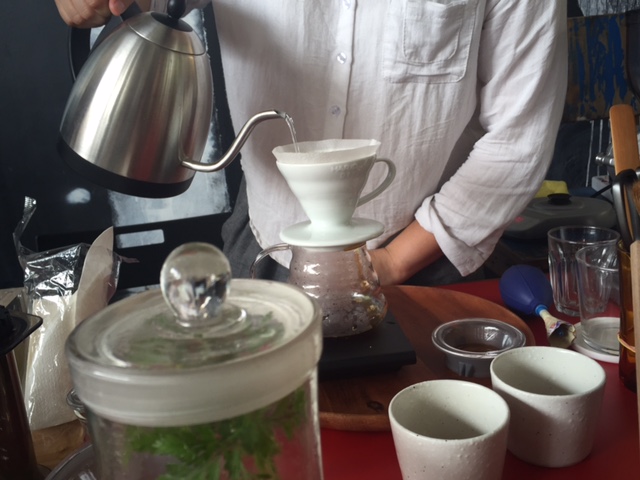
Coffee is the drink for Tsukuru and the characters in the story. As someone who loves coffee and cares  about the roast of the beans, I appreciate  one particular quote from the book ‘The fresh smell of coffee soon wafted through the apartment, the smell that separates night from day.' click

Unlike the Murakami’s other books, Colourless Tsukuru Tazaki is rather casually written with the usual wry observations interjected by the author. Since I do not read Japanese,  I can only read the English translation copy of the novel. I like  the minimalist writing style as I  can glide through the story in one sitting.


Sunday, May 1, 2016

At the interchange


Everyone of us is a concoction of our nature and nurture that comprise of  all the things we encounter and experience, past and present. How we respond and remember things are a matter of  our perceptions which are very much influenced by our own beliefs and education. We think in the way we choose to think and our thoughts are shaped by what we have come to believe. Education is our life  long vocation. If you think about it , there are a lot of things that are at odds with logic. I thus believe that we must not stop educating ourselves even if we might not find the real explanations nor the true reasons for everything that  has happened or is happening because life is multi-faceted. I also believe that everything is connected and nothing happens in isolation.

In The Forgetting Time written by Sharon Guskin, Noah Zimmerman is conceived after a one-night stand with a man whom Janie meets when she is on vacation in Trinidad as  she turns thirty-nine. Noah is Janie’s world and it breaks her heart when he has nightmares and sometimes pushes her away and asks for his real mother when Janie is his mother. Janie is called into Noah’s  pre-school where she is told that she needs  to seek professional help for her son. Noah is beyond his age as he speaks about scoring a baseball game, Harry Potter and  guns , things that a four year old would not possess any knowledge of  particularly when Janie has never exposed him to these things. Noah is very much terrified of water and bath is a constant battle between Janie and Noah. He also speaks of the time when he was Tommy and lived in the red house in the field in some place called Ashview. After sending him to different psychiatrists, she is at her wits end to find a cure for her troubled child. Enter Professor Jerome Anderson who is into research about reincarnations and consciousness and he, for many decades has been studying young children who seem to recall details from previous lives. Anderson is diagnosed with a rare form of Alphasia and  time is running out for him to prove his point about reincarnation and changeability of consciousness.

‘His legacy ---oh, he had had high hopes for himself, but he hadn’t gotten very far. There were so many things he still didn’t know. Why were some children born with memories of past lives, their bodies marked with the imprints of past traumas? Was it related (it had to be ) to the fact that 70 persecent of the previous personalities these children remembered had died traumatic deaths?’

Noah’s case seems to be Anderson’s only chance to finish his book on the research he has done. Janie is running out of money and  her work is very much disrupted due to Noah’s behaviour. She loves Noah thus she is desperate to find a cure for her son even if Anderson’s theory is not what she is ready to hear let alone accept.

‘ Janie believed in consistency. It was something she took pride in. She said ,”No crackers before bedtime,” and then she stuck with it .She had been even-tempered (mostly);she had been constant (as much as possible). Kids needed that.

She had tried to create order in Noah’s life the way her mother had created order in her own, after the chaos of living with her father. She didn’t remember much of the time before her father had left them. There was a memory of sitting high up on his shoulders at the state fair – but was that a real memory or something she made up from a picture she had ? There was the time the two of them went to the mall on some errand and he had spontaneously bought a huge stuffed polar bear for her, far too big for any room but the living room, and her mother objected but then laughed and let her keep it there beside the TV. There was the smell of his pipe and his scotch, and the sound of him banging on the door all night long when he drank and her mother wouldn’t let him in. There was her mother holding a water glass filled with red wine (the first and only time Janie had seen her drink). Telling her in the matter-of –fact voice she always had that she had asked him to leave and he wasn’t ever coming back, and she was right; he didn’t. Janie was ten then. She remembered that day perfectly, the startling sight of her mother drinking in the afternoon, the way the wine had splashed as her mother talked and Janie had been nervous it would spill over.'

The Forgetting Time is about the length a mother will go for her child and that it examines the possibility that consciousness might survive death. Ms Guskin's writing is beautiful. The novel is a fabulous debut, an engaging read indeed.

Hongkong