Sunday, August 30, 2015

Unplugged


Guggenheim Museum, Bilbao
A lot of things do not make sense. Technology should help us to free our time for doing stuff that interest us but somehow it is not necessarily so. Due to computerization and electronic data system, as  consumers and end users , we are compelled  to spend  our precious time going through some processes on our own.  Automated services  are in essence a form of self service that takes up all your time at your own cost. For instance, if you want to find out about certain status of your bank account, when you dial the toll-free number, you have to patiently press your account number and enter your personal particulars including pin code and your personal ID and by the time you press all the buttons and follow through the menu, you finally get to speak to a customer service officer who will ask you again all the  questions that only you are able to answer to verify that you are actually the account holder. As you do not wish to go through the recording message, you grit your teeth  and let the officer quiz you in the name of security and protecting your account. Then finally you get to ask the questions before you forget why you have wanted to speak to the customer  service personnel in the first place.

It is apparent that with the internet, we can perform and  execute tasks electronically and access  to information  24/7 thus it means that we can do things on our own timeline and wherever we are so long as there is network. We make virtual acquaintances and stay connected with friends and associates in cyberspace. Life is kept very busy by reason of  technology and if we are not careful, technology will dictate our lives  instead of  us having a control over technology.  Throughout our growing years, we are all programmed one way or other and as we become reliant on androids and computers,  we think and  function differently to keep up with technology and  social media.

I read disparately and the internet offers infinite choices of subjects. There are articles ranging from the right way to chop an onion to the telling signs of Alzheimer and if you get stuck reading these symptoms, you spend another one hour fretting over every bit of absent mindedness you have exhibited in the past weeks. I feel that the reason we become forgetful is that we are trying to compartmentalize our minds and our time in order to fit in all the things we do in cyberspace and also in the physical world.

In her book 'Why Grow Up' ,  Susan Neiman writes that she spends hours most days in cyberspace and is grateful for many of its resources but she suggests that we limit our time  ‘in cyberspace and experience action more palpable than making a cursor click’ . 
 In her book

Neiman  writes ,
‘Even a week off the web can work wonders for your imagination, and your sense of being in the world.’ 

Perhaps people do not like to second guess things. They want to be spoon fed and told what to do as it is easier that way. They like things straightforward. With the internet, we can easily google for information, instructions and directions without having to figure things out ourselves. Didn’t  I read somewhere that humans only use a fraction  of their mental power ?If we are  freeing our mental space , for what purpose are we  freeing our mental space ? Only in unplugging ourselves from time to time, we will leave  our minds less cluttered, our thoughts more focused. 

 To rise again at a decent hour written by Joshua Ferris is a very hilarious story. It is  about Paul D’Rourke, a 36 year-old dentist who despite having a thriving dental practice does not seem to fit into the modern age and a reluctant New Yorker, a curmudgeon, an atheist and a Red Sox fan. For someone who has no facebook account, one day, Paul O’Rouke discovers that an ex patient of his has impersonated him, created his profile and  is tweeting in his name and write about religion and talk about the Jews.The impersonator has also created an email account in his name. He is told by a strange religious group that he belongs to a growing sect and that he is an Ulm. The protagonist narrates, " No invention in the world, not the printing press or the telegraph, not the post office or the telephone, had done more to get people communicating than the Internet. But how did one person, the inaudible and insignificant single human voice, communicate with the Internet itself? To whom did it appeal an error? How did it seek redress? "
Here is a snippet from the novel. 
‘ I wanted nothing more than to say good morning first thing in the morning. Saying good morning was good for morale, converying to everyone in their turn, Isn’t it something? Here we are again, wits renewed , armpits refreshed, what exciting surprised does the day hold in store? But some mornings I couldn’t bring myself to do it . We were a cozy office of four; three good mornings, that’s all that was ever asked of me. And yet I ‘d withhold my good mornings. Ignoring the poignancy of everyone’s limited allotment of good mornings, I would not say good morning. Or I would in all innocence forget about our numbered opportunities to say good morning, that horrifying circumscription, and simply fail to say it. Or I would say good morning sparingly, begrudgingly, injudiciously, or tyrannically, I would say good morning to Abby and Betsy but not to Connie. Or to Betsy but not Abby or Connie. Or to Abby in front of Betsy , and to Betsy in front of Connie, but not to Connie. What was so good about it anyway, the too-often predictable, so- called new morning? It was usually precede by a long struggle for a short drowse that so many people call night. That was never sufficiently ceremonial to call for fresh greetings. So instead I’d say to them, “ Where’s the day’s schedule? “ If I said, “ Where’s the day’s schedule? “ I was saying that to Connie, who worked the desk.’

After reading Ferris’ third novel, I decided to read his second novel “ Unnamed” particularly after finding out that the protagonist is a successful lawyer who is on top of his game until he is hit by some mysterious illness. He walks aimlessly when the unknown illness hits him. A very depressing story that started off very promising but I ended up skimming through just to get to the end of the story. I  remember having read the author’s  first novel “ Then it came to an End” and had liked it . To rise again at a decent hour is quirky and  its dark humour makes me want to catch a Woody Allen film.
Montjuic Magic Fountain, Barcelona

Sunday, August 23, 2015

Becoming adult


Basilica De La Sagrada Familia , Barcelona
The central focus of parenting seems to be preparing children for conventional success . Since young age, every nurturing act is aimed at ushering a child to a life of accomplishments that is believed to be the key to a good life. Many of us have fallen prey to the system where certain conceptions about measure of conventional successes have been in place.  As parents, we cannot leave our children to their own devices for we are afraid that they may go astray or become idle so we guide them zealously with what we know but they really must figure things out themselves. It is necessary that we must encourage them to trust their own judgments and  grow up as individuals in a less than ideal world.

Becoming adult is indeed a daunting task. As a parent, I tell my children they can do what they want  if they have the resolve and convictions to follow through what is on their wish list. Often in chasing what we feel will make us happy and fulfilled, we lose sight of engaging ourselves in moments that actually matter . Growing up does not mean renouncing your hopes and dreams, growing up means trying to make sense of the world, living with uncertainties and making the best of what you have and what you can do.

Growing up needs courage because it means being responsible for yourself, learning to trust your own judgment,  taking responsibility for your actions and omissions.We must make sensible choices that work for us by knowing our strengths and weaknesses but how do we know by thinking rationally and acting sensibly , we are not limiting ourselves? Growing up means finding a place in the world and not losing yourself  despite experiencing unfair treatments and acknowledging the presence of injustice around the world.  

In her book Why Grow Up, Susan Neiman writes @page 73
‘You have probably forgotten the details of your first unfairness, presumably because it happened very early, and was followed by many more. Still Barrie is probably right to say no one ever gets over it, and the reason Peter Pan remains an eternal child is that each succeeding unfairness is a surprise. None is ever internalized, so his trust in the world remains unscathed.

Not so for the rest of us; Peter Pan is a fairy tale. Even babies, as we’ll see, sense and suffer from a world that doesn’t fit. It’s the beginning of alienation , but also of indignation that, if properly guided, will be needed to make a life active. What guidance is proper? We want our children to see as little suffering as possible, and we know that even Buddha’s royal father couldn’t shield him. Most of us have considerably fewer resources than he did.  When my own son was eleven or twelve he came home from school complaining that a teacher had treated him unfairly, and hearing the details I thought he was right. Here’s what I told him : This won’t be the last time that someone in power treats you unfairly. They may be threatened or jealous or simply tired, they may prefer the kid or the employee who flatters or falls. Besides reading and writing and arithmetic, one of the things you need to learn in school is how to live with that – without losing yourself.  Was the balance right? After too many encounters with unfairness I could not share his outrage. We want our children to remain awake to injustice; we just don’t want them to be undone by it. I was rather pleased with my little speech; it was certainly better than anything I’d heard as a child, when my own parents’ refusal to acknowledge that a teacher might be anything less than benign left me not only alone with my indignation but deeply confused: weren’t they just saying  the is is the ought ? But the problem is one of proportion.’
Only butter butters (Restaurant  Story , London)
Growing up means having to interact and deal with people who are different from us. Growing up means knowing how to manage one’s expectations and emotions. Growing up means being tolerant of others and embracing all our differences and failings. Ideally, growing up leads to better judgments. Growing up is simply about thinking for ourselves. But it does not mean you have to give up  striving for what you think is the ideal world.

Susan Neiman also writes, 

‘Growing up is a process of sifting through your parents’ choices about everything: the music you couldn’t help hearing because it was playing on a stereo you couldn’t reach, the religion you couldn’t help believing because you were taken to sermons, or holidays in a car you couldn’t drive, the neighbourhood they set up home in, or move to when they changed jobs, and a host of general values you will not even recognize as values until you are old enough to get out in the world and encounter other ones. Sometimes when you’re sifting, with any luck at all, you’ll be able to say and thank your parents for it one way or another, if only by living in a way that proves them right. On the other hand, if you don’t reject any of their choices you are not grown-up-if only because their choices were made in a time that isn’t this one, and not all of them fit into the world you now inhabit.’

Why Grow Up does not tell you how but why it is necessary to grow up for coming of age itself is an ideal one should strive for. Susan Neiman shares her thoughts about aging and the need to build a new model of maturity in the 21st century from reading disparately and widely and  in her book , she discusses works by philosophers namely  Immanuel Kant, Jean- Jacques Rousseau and Simone de Beauvoir.

In conclusion, grownups are not boring and being grown-up is itself an ideal.
Monmouth Cafe, London


Wednesday, July 29, 2015

The Winner Takes it All


When we are young, our parents tell us what the world is and that we have to accept the world as it is. When we grow up we have to face the fact that we will never get the world we want and our outlook will change. While I do not want to get cynical nor be naively idealistic, I try to adopt an open mind and attempt to see things from various angles as I believe that there are many sides to every story. Not all black is black nor white is white.

Free will is an illusion as we live in an informed world with both unsolicited and solicited information. We  live with what we have been told since infancy days. Those who manage to lead  tell the other people what they actually want. In order to progress you cannot assume that you have things all figured out as that might stifle your growth. I can never be certain of my perceptions of things nor think that I  know all about the workings of the world. All I know is one must be able to break free from  social expectations and all those rules that have been implemented by people who think they can make you think the way they want you to think. You do not necessarily know  the stuff of thought others carry in their heads and their intentions and they may not think like you. What matters is you must know the thoughts you carry in your own head and where your sentiments lie. 

We grow up and live in a world that is full of prejudices and bigotry.  I so want to  avoid acting  unjust and  be more tolerant than most people around me and  I often find myself failing in such attempts. In Go Set a Watchman, Harper Lee writes, " Every man's island, Jean Louise, everyman's watchman, is his conscience. There is no such thing as a collective conscience." 

When I first read about Harper Lee’s new book and all the write up about how the character, Atticus Finch had become a different man in his old age, my first response was : “ I do not want to spoil the image of the heroic character from Mockingbird and I probably should not read Go Set a Watchman” . A couple of days  after  Watchman was launched,  I  rationalized that Atticus Finch was after all a fictitious character and  I could not possibly idolize a fictitious character. I have always been one who finds inspirations from reading fictions and I learn things from watching movies and reading fictions. Fiction writers  tell us who we are as human beings.

La Sagrada Família, Barcelona
The novel Go Set a Watchman has courted much controversy.  While I am certainly not in the position to comment about its writing, I find that the writing could do with some editing as it feels raw unlike Mockingbird that was extremely well crafted. Mockingbird moved me to tears when I read it while Watchman made me ponder. I read from the news articles that  the original manuscript now published as Watchman was first  written in the mid-1950s. The editor then persuaded Harper Lee to rewrite the story from the voice of young Jean Louise aka Scout hence To Kill a Mockingbird, the Pulitzer prize winner and the lawyer character, Atticus Finch that we came to love by reason of  the ideals he represents, integrity, kindness, a loving father and a fearless lawyer who believes in justice and fairness for all men.  In Watchman, Jean Louise Finch is now 26 years old and practises law in New York city. When she makes her annual visit to her hometown in Maycomb, she has an  awakening as she comes to know about her dad’s racist stand at a time of early civil unrest. She feels cheated and becomes hysterical when she realizes that her dad is not what he has stood for in her life. It is all a little confusing at times but as her uncle explains to Scout ,

‘Dr Finch stretched out his legs. “It’s rather complicated,” he said, “and I don’t want you to fall into the tiresome error of being conceited about your complexes-you’d bore us for the rest of our lives with that, so we’ll keep away from it. Every man’s island, Jean Louise, every man’s watchman, is his conscience. There is no such thing as a collective conscious.”

   This was news, coming from him. But let him talk, he would find his way to the nineteenth century somehow.
   “ ….now you, Miss, born with your own conscience, somewhere along the line fastened it like a barnacle onto your father’s. As you grew up, when you were grown, totally unknown to yourself, you confused your father with God. You never saw him as a man with a man’s heart, and a man’s failings – I’ll grant you it may have been hard to see, he makes so few mistakes, but he makes ‘em like all of us. You were an emotional cripple, leaning on him, getting the answers from him, assuming that your answers would always be his answers.”
      She listened to the figure on the sofa.
    “ When you happened along and saw him doing something that seemed to you to be the antithesis of his conscience – your conscience –you literally could not stand it. It made you physically ill. Life became hell on earth for you. You had  to kill yourself, or he had to kill you to get you functioning as a separate entity.”’
La Sagrada Familia, Barcelona
Dr Finch calls his niece a bigot.
‘Dr Finch bit his under lip and let it go. “ Um hum. A bigot. Not a big one, just an ordinary turnip-sized bigot.”
 Jean Louise rose and went to the bookshelves. She pulled down a dictionary and leafed through it. “ Bigot,” she read. “ Noun. One obstinately or intolerably devoted to his own church, party , belief ,  or opinion.”  Explain yourself, sir.”
‘ I was just tryin’ to answer your running question. Let me elaborate a little on that definition. What does a bigot do when he meets someone who challenges his opinions? He doesn’t give. He stays rigid. Doesn’t even try to listen, just lashes out. Now you, you were turned inside out by the granddaddy of all father things, so you ran. And how you ran.
    You’ve no doubt heard some pretty offensive talk since you’ve been home, but instead of getting on your charger and blindly striking it down, you turned and ran. You said, in effect, ‘ I don’t like the way these people do, so I have no time for them.’ You’d better take time for ‘em, honey, otherwise you’ll never grow. You ‘ll be the same at sixty as you are now – then you’ll be a case and not my niece. You have a tendency not to give anybody elbow room in your mind for their ideas, no matter how silly you think they are.’

In the book, Harper Lee describes Scout’s uncle:
‘Dr  John Hale Finch was no taller than his niece, who was five seven. His father had given him a high-bridged nose, a stern nether lip, and high cheekbones. He looked like his sister Alexander, but their physical resemblance ended at the neck : Dr Finch was spare, almost spidery; his sister was of firmer proportions. He was the reason Atticus did not marry until he was forty – when the time came for John Hale Finch to chose a profession, he chose medicine. ‘

‘Dr Finch became a bone man, practiced in Nashville,played the stock market with shrewdness, and by the time he was forty-five he had accumulated enough money to retire and devote all his time to his first and aiding love, Victorian literature, a pursuit that in itself earned him the reputation of being Maycomb County’s most leaned licensed eccentric.’

Word on the Water, London
Scout’s  uncle was  the other aging man ‘who saw her through her loneliest and most difficult hours, through the malignant limbo of turning from a howling tomboy  into a young woman.’  I can imagine that the eccentricity of the uncle can make him seem like a borderline case.  There is something else the uncle says that resonates with me .

“ Remember this also : it’s always easy to look back and see what we were, yesterday, ten years ago. It is hard to see what we are. If you can master that trick , you’ll get along.”

Though her perceptions of what her dad stands for have crushed drastically, Dr Finch shows Jean Louis that she has to figure out her own conscience and also the fact that despite all the terrible things she has said to her dad including calling him a 'double dealing, ring-tailed old son of a bitch', the love of her father remains unchanged. Nothing is absolute.  Humanity is complicated. Maybe that is what  Harper Lee is telling us. To me both To Kill a Mockingbird and Go Set a Watchman are  about  growing up and coming of age. There is an excellent article by Randall Kennedy under Sunday Book Review in New York Times that says  '"Go Set a Watchman" demands that its readers abandon the immature sentimentality ingrained by middle school and the film adaptation of "To Kill a Mockingbird"'.http://www.nytimes.com/2015/07/14/books/review/harper-lees-go-set-a-watchman.html?emc=edit_bk_20150731&nl=books&nlid=54605499&_r=0  

Go Set a Watchman is definitely more ambitious and the constant presence of  ambivalence is real and not only in fictions. As I write this, Abba’s song ‘The winner takes it all’ is ringing in my head and next to me is the new book “Why Grow Up” written by Susan  Neiman. Go Set a Watchman is the winner of the 2015 Goodreads Choice Awards  for fiction.


Monday, July 27, 2015

Time in a Bottle


Since I need to be fully functioning at every hour of the day to accomplish all that reading, writing , learning and work that has to be attended to, I reckon it is such a waste of time and energy to get wound up over things. How debilitating it will be if I allow such feelings of disenchantment to affect my being. I therefore resolve to live in the present and endeavour to be mindful of my thoughts.

In order to keep ourselves happy, we have to free ourselves from thinking unhappy thoughts. We have to free ourselves from the damage caused by the incidents that happened in the past, sometimes there are childhood traumas that need to be revisited to understand our fears, our worries and our dilemmas. Like Rosemary Cooke in the fiction We Are All Completely Beside Ourselves written  by Karen Joy Fowler, we cannot go forward without going back to the times when certain happenings or memory of these incidents had caused a mark in our lives.

In the fiction written by Fowler , Fern had arrived when Rosemary  was just over one month old and Fern was just shy of three months. Rosemary felt her loss in a powerful way when Fern was sent away. This is how Rosemary’s mother described her and Fern:

‘MOM SAID:

         When Fern woke up, she woke up. Spun like a pinwheel. Burst like a sunburst. Swung through our house like a miniature Colossus. You remember how Dad used to call her our Mighty Whirlitzer? All the noise and color and excitement of Mardi Gras, and right in our very own home.

       When you got just a little older, you and she were quite the team. She’d open the cupboards and you’d pull out every pot, every pan. She could work the childproof locks in a heartbeat, but she didn’t have your stick-to-itiveness. Remember how obsessed she was with shoelaces? We were tripping over our feet because Fern had untied our shoelaces without us noticing.

     She’d climb up in the closets and pull the coats from the hangers, drop them down to you below. Fetch coins from my purse for you to suck on. Open the drawers and hand you the pins and the needles , the scissors and the knives.’

As the daughter of a psychology professor at Indiana University, Rosemary was raised with a chimpanzee as part of a scientific experiment. When Fern was sent away, both Rosemary and her brother Lowell were shattered. Lowell blamed Rosemary for Fern’s departure and he became an animal activist to the point of no return. Rosemary asked her mother if she was worried about her and what the impact might be to adopt a chimpanzee and introduced her as her twin sister.  Her mother replied,

“ Of course I did,” she said.” I worried about that all the time. But you  adored Fern. You were a happy, happy child.”
“ Was I ? I don’t remember.”
“Absolutely. I worried about what  being Fern’s sister would do to you, but I wanted it for you, too.”  The candlelight was casting shadow puppets in the kitchen. The wine was red. Mom took another sip and turned her softly sagging face away from mine. “I wanted you to have an extraordinary life,” she said.
Is the reason given by Rosemary’s mother good enough to exonerate her parents from all that damage caused by her early years growing up with a chimpanzee whose exile had subsequently caused her to carry the weight of her guilt till her adult years ? It was an interesting story about how  parents might have damaged their children even if they have the best of intentions.

When Rosemary went to college,  as part of her brand new start, she made a careful decision never ever tell anyone about her sister, Fern. She shared a room with Scully who was gregarious and outgoing. So they had all these people who came to their room and they carried on about  "the Whac-A-Mole dynamics of the homes they'd just left. Their parents were so weird!!"

‘I’d come back from class or dinner, or I ‘d wake up in the middle of the night, and there’d be a half-dozen freshmen, sitting with their backs against the walls, carrying on about the Whac-A-Mole dynamics of the homes they’d just left. Their parents were so weird! Like Scully, they’d just figured that out. Every single one of them had weird parents.

One of them had a mother who’d once grounded her a whole summer because she’d gotten a B-plus in biology. Her mother had grown up in some part of Delhi where they didn’t abide B-pluses.

One of them had a father who made the whole family stand at the refrigerator and down a glass of orange juice before going out for breakfast, because restaurant orange juice was too expensive to order, but you could hardly call it breakfast without.’

So it appeared to Rosemary that every single one of Scully's friends had weird parents.

I was first drawn to the title of the book We Are All Completely Beside Ourselves  so when  my daughter’s package that she had shipped home finally arrived, I was glad to get my hand on her copy of the novel. The fiction is smartly told about sibling love and rivalry and what constitutes a family. This is the first book by Karen Joy Fowler that I have ever read  and  I will be seeking out her earlier fictions when I next hit the bookstore.

Tuesday, June 23, 2015

A Wondrous Life


I have not been able to feel bored as there are always  books that I want to read and projects I want to work on. There are so many good books too little time. Amidst my work and commitments, I need to  fit in reading and writing and every day feels like a race. THIS IS THE STORY OF A HAPPY MARRIAGE, a  memoir by Ann Patchett  tells about how she manages the balance in her life between writing and all that matters in her life. Ann Patchett has the right aptitude and resolve. I enjoy all the insights that she shares with her readers.

Finding the right balance between what we love to do and what needs to be done is a constant challenge. But what if what we love to do is actually what needs to be done?

One afternoon, a man walked into my office seeking some legal advice. He was troubled as his wife of thirty years had taken off and she had decided to stay away from the family. When confronted, she told him that she had done enough for him and their three children who had since grown up, the youngest son seventeen going on to eighteen. He reiterated that he had been a good husband as he did not have any extra-marital affairs. He disclosed that he had regularly gone for drinks with the boys and frequented karoeke lounges and whenever he stayed out late, his wife used to telephone him and wondered about those women at such joints. After hearing his narration, it  sounded like he wanted the wife to continue feeling needy and insecure. Now that his wife has decided to make a change in her dreary life, he is terribly upset and accuses her of not thinking about the family. And to top it all, he  blamed her new woman friend who had brought about the change in her attitude that subsequently caused the disruption in his  family life.

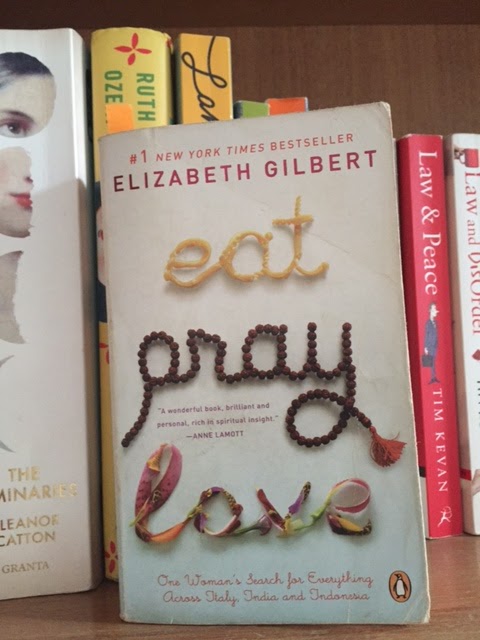
Women on a quest for change and freedom is a common theme. Elizabeth Gilbert had written the memoir “ Eat Pray Love”  about her year of travel that ended up in her meeting her present husband, a wonderful love story. In her early thirties, Elizabeth Gilbert had everything most women were supposed to want-husband, country home and successful career.  Instead of feeling happy and fulfilled, she felt confused and depressed. She divorced her husband and went on a trip to Italy, India and Indonesia.

As it is  a self- discovery voyage, Gilbert may at times  ramble on a bit and sound self- absorbed. Nonetheless the book is a page turner and the characters that she has met during her travel are colourful and fiction like. Her narration is for the most part lively and come across as sincere and honest. 


This is an extract from  what she wrote about her experience on meditation .   

‘When I tried this morning, after an hour or so of unhappy thinking , to dip back into my meditation. I took a new idea with me : compassion.  I asked my heart if it could please infuse my soul with a more generous perspective on my mind’s workings. Instead of thinking that I was a failure, could I perhaps accept that I am only a human being- and a normal one, at that ? The thoughts came up as usual –OK, so it will be -and then the attendant emotions rose, too. I began feeling frustrated and judgmental about myself, lonely and angry. But then a fierce response boiled up from somewhere in the deepest caverns of my heart, and I told myself, “ I will not judge you for these thoughts.”

My mind tried to protest, said, “ Yeah, but you ‘re such a failure, you ‘re such a loser, you’ll never amount to anything -”

But suddenly it was like a lion was roaring from within my chest, drowning all this claptrap out. A voice bellowed in me like nothing I had ever heard before. It was so internally, eternally loud that I actually clamped my hand over my mouth because I was afraid that if I opened my mouth and let this sound out, it would shake the foundations of buildings as far away as Detroit.”
And this is what it roared:
      YOU HAVE NO IDEA
          HOW  STRONG MY LOVE IS !!!!!!!!
‘The chattering, negative thoughts in my mind scattered in the wind of this statement like birds and jackrabbits and antelopes – they hightailed it out of there, terrified. Silence followed. An intense , vibrating ,awed silence. The lion in the giant savannah of my heart surveyed his newly quiet kingdom with satisfaction. He licked his great chips once, closed his yellow eyes and went back to sleep.
   And then , in that regal silence, finally – I began to mediate on ( and with ) God.’

Gilbert  did come across as someone who had an unlimited reserve  of good luck as she embarked on her self-discovery journey from eating and learning Italian in Italy to spending six weeks at an Ashram in India with a view to seek inner peace through meditation  and subsequently heading to Bali for the remaining part of her sojourn. As most of us know that we do not have neither the resources nor the courage to make such a trip of a lifetime, the memoir definitely makes a fun and inspiring read.

Saturday, June 6, 2015

Be Inspired


These days when the adults get together, it  appears to be a norm that children  are kept occupied with a smart phone or an iPad or a Samsung galaxy notebook. A nineteen year old whom I am acquainted with tells us how he has seen a toddler  sitting inside a pram holding up an iPad ( presumably an iPad mini). When they were toddlers, I used to give my daughters cloth books that were washable,  picture books, simple jigsaw puzzles or some children’s toys to keep them occupied. That was two decades ago. These days, games are available on apps and there are ample of them. A colleague  laments that he has three young kids and he has to get not just one iPad. Imagine having to contain your kids with electronic devices even if you are not keeping up with the Joneses and you have to be realistic about instagram, facebook, twitter, pinterest, wechat as they are all part of the technology evolution. The  virtual world is expanding its horizon at a fast pace. The way people interact with one another and disseminate information are very much dependent upon social medias and because we are all social beings, etiquettes  that might have not been acceptable may now be part of the changing social culture.

For me, I cannot imagine myself playing candy crush and the likes as I need all the minutes and hours to read and pursuing my passion in writing. I loved to write as a child. When I was in primary school, I  listed “ writer”作家 (Zuòjiā) as what I wanted to be when we were asked to write  Chinese essays with topics like“ What would you like to do when you grow up?”. I probably had  no inkling what the job would entail and very faint idea about what it had meant to be a 作家 (Zuòjiā). As an adolescent. I had always been interested in writing, dramas and films but I have chosen law as my career path as I was being practical. Decades later, I am ambivalent about whether I had made the right decision. I feel that competence, confidence and assertiveness may be the personality traits that are ascribed to a good lawyer, to be a great lawyer is another thing altogether. I only wish that I had Ann Patchett’s conviction and resolve when I was in my 20s. She knew that she wanted to be a writer since she was six years old. 


Ann Patchett wrote in her memoir THIS IS THE STORY OF A HAPPY MARRIAGE,
“ If I was twelve that Christmas Eve, I already knew I wanted to be a writer. That knowledge goes back as early as six, as early as the start of school and maybe even before that.  I may at times forget the details of my life  but I remember the stories I read. ….”

Patchett writes with such passion and honesty. I thoroughly enjoy reading the essays collection in THIS IS THE STORY OF A HAPPY MARRIAGE.

In her essay entitled “ On Responsibility” , Ann Patchett wrote :
“ I AM NOT RESPONSIBLE for much. I do not have children who have to get to school on time and wear matching shoes and be taught the difference between right and wrong. I do not have a job in which the well being of a company or the safety of the nation or the health of anyone at all is resting on my shoulders. I have a couple of plants. I must remember to water. I make a point of paying my taxes on time. I take care of myself, but that’s not worth mentioning. I pitch in and help other people when I can, but they are people who could find the same help elsewhere if I went on vacation. When I think of whom I am responsible for, truly responsible for, I can whittle the list down to my dog and my grandmother, and it just so happens that last week they were both sick.”    

The essay entitled “The Mercies” reminds me of the first two  years of my secondary school when I was taught by Sister Stephen and Sister Gertrude at the convent I attended. Sister Stephen was the principal of the school and due to her love for music, she arranged for a choral teacher and a violin teacher for our class. I remember Sister Gertrude as being gentle, genteel and  soft spoken. My best friend in school then became a Catholic and she grew very close to Sister Gertrude. For some reasons, I am a Buddhist and agnostic and have always been. Although I was a vanguard and used to be able to recite  Hail Mary and Our Father very well at school,  I never got round to knowing much about the nuns.

Ann wrote :
“When I was a girl in Catholic school I was open to the idea of being a nun, a mother, a wife , but whenever I closed my eyes and listened (and there was plenty of time for listening – in  chapel, in math class, in basketball games-we were told the news could come at any time) the voice I heard was consistent: Be a writer. It didn’t matter that “writer” had never been listed as one of our options. I knew that for me this was the truth, and to that end I found the nuns to be invaluable examples. I was , after all, educated by a group of women who had in essence jumped ship, ignored the strongest warnings of their fathers and brothers in order to follow their own clear direction. They were working women who had given every aspect of their lives over to their belief, as I intended to give my life over to my belief.  The nuns’ existence was not so far from the kind of singular life I imagined for myself, even if God wasn’t the object of my devotion.” 

How she met her husband Karl and live happily after is a sweet story she shares.  She also tells the story about how she started a bookstore with her partner when Borders were closing down . Maybe the book shop is working because she is an author and because her partner, Karen works like life depends on the bookstore or simply because they just got lucky.  Whatever the reasons are, Ann Patchett has the right attitude.

“ But my luck has made me believe that changing the course of the corporate world is possible. Amazon doesn’t get to make all the decision; the people can make them by how and where they spend their money. If what a bookstore offers matters to you , then shop at a bookstore. If you feel that the experience of reading a book is valuable, then read the book. This is how we change the world: we grab hold of it. We change ourselves.”

Kudos to Ann Patchett who is  fully committed to the art and craft of writing, books and the dog and people who matter to her. And thanks to writers and avid readers throughout the world, books and reading are very much alive.


Thursday, June 4, 2015

Dear Mother


After having read Bring up the bodies, I could not wait to get my hand on another novel written by Hilary Mantel. Earlier this year, I had placed an order for her debut novel with  a local independent bookstore and was glad that my copy of  Every day is Mother’s day arrived in May. The timing  was  perfect in that Mother’s Day was celebrated a couple of weeks before  and I  had just posted an essay about how some men might not be too thrilled with the idea of parenting, as described by  John O’Farell through the sentiments expressed by the protagonist, Michael Adams who live a double life in The Best a Man Can Get , a satire written by O’Farell.        http://lifang-leehong.blogspot.com/2015/05/parenthood.html


Similarly the mothers in the debut novel by Hilary Mantel do not seem to  cope well with their parenting jobs either. In Every day is Mother’s day, Evelyn Axon is a medium by trade and her daughter, Muriel is a half-wit by nature but she is devious. Young and inexperienced social worker, Isabel Field meet Colin Sidney in a creative class and start an affair that is doomed from the start as Colin is married to Sylvia who is now expecting their fourth child. Evelyn and Muriel live next door to Colin’s sister, Florence. Colin and his wife, Sylvia do not seem to be able to  manage their three kids well. Colin habitually enroll  in courses and classes after work  to get away from his wife , Sylvia who has grown into a highly strung lady. Poor Sylvia.

Mantel writes,
‘Colin moved and took her by the arm. A corner of the vegetable rack caught him painfully on the shin.

“ This is what I stay for,” he said.” They’re your children, you wanted them. Can’t you manage better than this ? Do you realize this is what I stay for?”

“Stay?” Sylvia gaped. “And where are you planning to go? What are you talking about ? Who else in the name of God would want you?” Her mouth quivered like Karen’s , in disbelief, and suddenly tears plopped out of her pale blue eyes and ran down onto her housecoat, Christmas or no Christmas, the first in years.’

Both Colin and Sylvia have been invited to dinner and at the last minute, their baby- sitter has decided not to turn up as her grandpa is visiting and when Colin tries to persuade her about earning her pocket money, she responds with this:
“Well, it’s only one fifty, isn’t it, and if Grandad sees me he gives me a fiver.”

Here is part of the exchange between Colin and Sylvia when they have to figure out who they can entrust  their children with as they are due at their dinner host’s place in forty-five minutes.
Mantel writes ,
“ You phone her,” Colin said. “ You got us into this mess.”
“I’d like to know why it’s always my problem to fix up a babysitter. You always leave it to me and then you criticize. It’s you that wants to go this dinner, not me.”

“ All right,” Colin said, “all right. Then I’ll just phone up Frank and say we can’t make it, shall I ? Frank goes to a lot of trouble over his dinner parties. He’s very interested in cooking and he goes to a lot of trouble, trying to select the right guests.”

“ And I go to trouble every night of the week. You don’t think about that.”

In Every Day is Mother’s Day, two stories run parallel and the characters  are intertwined. A horrible secret lurks in the darkness of the Axon household as Isabel the social worker feels duty bound to investigate, the result is  terrifying and at the same time hilarious. Mantel is a very good story teller and you can  visualize  the characters and the surroundings as you read all the descriptions  through her prose.
‘Click, click, click, said the mock-cros. They were Mrs Sidney’s shoes. She passed without mishap along the Avenue, over that flagstone with its wickedly raised edge where Mr Tillotson had tripped last winter and sustained his fracture; they had petitioned the council. Mrs Sidney's good legs, the legs of a woman of twenty-five, moved like scissors down the street. Her face was white and tired, her scarlet lips spoke of an effort at gaiety. She had carried the colour over the line of her thin lips into a curvaceous bow; she had once red in a magazine that this could be done.’

I will have to get the next novel Vacant Possession by Hilary Mantel  as the story continues with the same characters.