Monday, May 18, 2015

Parenthood


We do not necessarily know the stuff of thought others carry in their heads no matter how close or chummy we are with them unless they talk to us. When two people get married, becoming parents and raising children seem to be the natural order of things. When the child is born, often both parents if not one  parent has this all consuming obsessive love for the little one that the entire relationship takes on a different dynamic where attention is shifted to the baby. What if parenthood is thrust upon a man or a woman when he or she is not quite ready for it or worse they are  just never cut out to be parents ? Maybe due to biological make up, a woman seems more ready to  valiantly take on her role as a mother coping on her own even in the absence of a man who is away due to work and various commitments.  It is commonly known that after a day’s work, some married men  unwind themselves by taking part in activities such as golfing and drinking with friends. Some of these men are probably keeping scores that  their work stress is so great that it is perfectly legitimate for them to hang out with friends to de-stress and re-create those carefree days or that they are networking and looking for opportunities  to  a better future. If they  assume  that the children will form the substratum of their marriage, they will sooner or later find out that such a notion is a misconception. They must know that their  children will grow up and they might just have  missed their chances of caring and nurturing them. 

The Best a Man Can Get written by John O’Farrell tells a story about  a man who shares a bachelor pad with three other men in their twenties in order to escape from the exhausting life of a parent to  a two year old , a baby and a  third one  is  on his way. Michael Adams is living a  double life. He  is a jingle writer for adverts so he tells his wife, Catherine that he has to pull all-nighters  when in fact he escapes to a bachelor pad where he spends his days lying in bed , playing computer and musical trivia games and occasionally  gets some work done and when he is up to it, he crosses the Thames and goes back to his real life. During the antenatal classes that he attends with his wife for their third baby, he starts airing the reality to the crowd of fathers-to-be who are new parents. He allows himself a private chuckle at all the naïve enthusiasm of the first – time parents who are all completely consumed by their child before it had even been born. He wants to say to them, ‘don’t keep coming to these parenting classes , go to the cinema together instead, go out for dinner, just do things for yourselves while you still can.’

The story is told in the protagonist’s voice.
‘They were as eager to hear about my experience as I was to recount them. No other man in the room had yet become a parent and they looked to me as the war- scarred veteran, back from battle, full of horrific tales from the front line of fatherhood.
Millennium Bridge,London
    “But the thing that really disappears overnight is your youth. Suddenly your youth is over. I tried to artificially recreate mine,” I said enigmatically, ’but it hasn’t really worked. As soon as you become responsible for someone very, very young, it suddenly makes you feel very, very old. For one thing you are exhausted, both physically and emotionally, and if you have time to still do any of the things you did as a young man, you will find yourself struggling to tackle them with the weary foreboding of an overwhelmed pensioner. By the time the children start to be less physically demanding you’ve aged ten years in he space of two or three, so it’s too late to get it back anyway. You will look in the mirror at the graying hair and sagging face nd you will think, Where the bloody hell did he come from? But you don’t just look old and feel old in your bones, you think old. Your fuss and your worry about your children, but you don’t realize or care that you’re walking down the street with odd socks and your hair sticking up. You become fretful and sensible and organized , and if you ever do anything carefree and spontaneous together it’s because two weeks ago you set aside an hour to do something carefree and spontaneous together. The day that baby comes out it’s over. Your independence, your youth. Your pride-everything that made you what you were. You have to start again from scratch.’

The protagonist laments,
‘In all the adverts that I’d arranged the music for , the families always had such fun; they always looked so comfortable with each other. Even though I worked in the industry I still hadn’t seen through the lies.’

‘ The adverts told us we could have it all , we could be great dads and still go off snowboarding and earn lots of money and pop out of the business meeting to tell our children a bedtime story on the mobile phone. But it can’t be done. Work, family and self; it’s an impossible Rubik’s Cube, You can’t be a hands-on, sensitive father and a tough ,high- earning businessman and a pillar of your local community and a handy do-it- yourself Mr Fixit and a romantic, attentive husband- something has to give . In my case, everything.’

Mike feels guilty about his deception though he tries to justify that it is for the sake of the marriage. When Catherine comes to know about  Mike's double life, he  almost loses it all. In fictions things are usually okay at the end. Nonetheless the book is a satire that  gives insights into the psyches of men and women and the demands of contemporary living. O’Farell’s observations about parenthood and his descriptions about the power play and dynamics in a couple are very real and often hilarious. It is candid and funny.

Monaco


Thursday, May 14, 2015

The World of Words


So many good books, so little time. If I could complete one fiction per week, I can only complete around 50 to 60 novels a year.  That is wishful thinking considering amidst my work and doing all the things I like and dislike, I do not actually get to read one fiction per week  unless it is a short one.

I also read books other than fictions. I have started reading the memoir This is the Story of a Happy Marriage by Ann Patchett . Here is a passage that I find inspiring for anyone who wants to write.

‘Art stands on the shoulders of craft, which means that to get to the art you must master the craft. If you want to write , practice writing. Practice it for hours a day, not to come up with a story you can publish, but because you long to learn how to write well, because there is something that you alone can say. Write the story , learn from it, put it away, write another story. Think of a sink pipe filled with sticky sediment. The only way to get clean water is to force a small ocean through the tap. Most of us are full up with bad stories, boring stories, self-indulgent stories, searing works of unendurable melodrama. We must get all of them out of our system in order to find the good stories that may or may not exist in the fresh water underneath. Does this sound like a lot of work without any guarantee of success ? Well yes, but it also calls into question our definition of success.’

The only way to learn to write is by writing and the pleasure is in the writing. I cannot agree more. Ms Patchett aspired to be a writer since she was twelve years old. She always knew that she wrote because it was her joy.

I find joy in reading and writing. Reading and writing are solitary acts and nothing pleases me more than allowing me the time and space to read  and write alone.  In his essay entitled “ Why Bother?” ( How to be Alone, Jonathan Franzen )  Franzen wrote this :
‘ At the heart of my despair about the novel had been a conflict between a feeling that I should Address the Culture and Bring News to the Mainstream, and my desire to write about the things closest to me , to lose myself in the characters and locales I loved. Writing, and reading too, had become a grim duty; and considering the poor pay, there is seriously no point in doing either if you’re not having fun.’

Here is what Franzen transcribed from a letter he had received from Don DeLillo, to whom he had written in distress.

‘The novel is whatever novelists are doing at a given time. If we’re not doing the big social novel fifteen years from now, it’ll probably mean our sensibilities have changed in ways that make such work less compelling to us - we won’t stop because the market die up. The writer leads, he doesn’t follow. The dynamic lives in the writer’s mind, not in the side of the audience. And if the social novel lives, but only barely, surviving in the cracks and ruts of the culture, maybe it will be taken more seriously, as an endangered spectacle. A reduced context but a more intense one.
     Writing is a form of personal freedom. It frees us from the mass identity we see in the making all around .In the end, writers will write not to be outlaw heroes of some under culture but mainly to save themselves, to survive as individuals.’

Reading and writing require one to be alone in his or her own contemplation . As I read, ideas bounce from one book to another and every book is an invitation to savor, experience , learn and grow. There are great books for every reader. In order to improve one’s writing craft,  one has to keep writing. Ideas are everywhere, writing helps me to formulate my thoughts and as I compose , I reflect. 

Wednesday, April 29, 2015

My Wish List


On se ment toujours. We are always telling ourselves lies. Such a powerful opening line. After reading Bring up the Bodies by Hilary Mantel, I wanted a quick read so I read the book   My Wish List in one sitting, the  English translation of the French novel La liste de mes envies written by Grégoire Delacourt. The English translation  is by Anthea Bell.

We all have our wish lists. Some wishes will remain wishful thinking while some dreams can be achieved if we work hard and are determined  enough. There are always things we regret and wish we had not  got ourselves into some situations we are in or wish that we could have done things differently  but  would you really want to trade your life for the life of your dreams if you could  ? What if you won the lottery ?
In My Wish List, Jocelyne Guerbnette lives in Arras where she runs a fabric shop and a successful blog about knitting, embroidery and dressmaking. She is married to the same man for twenty-one years and has raised two children who are living their own lives now.  She is beginning to wonder what happened to those dreams she had when she was seventeen and whether her life could have been different.  It is a familiar theme. One chance in seventy-six million, and it happened to her. She has won the lottery. Yet the protagonist somehow has a sense of ambivalence when she finds out that she has won eighteen  million euros , 18,547,301 euros and 28 centimes to be exact .You would think that the answer is straightforward because with all those money, you could leave your mundane job, change your wardrobe, get the car and house you want, go places, dine in all the Michelin starred restaurants  and pursue whatever luxuries  that money can buy. Not Jocelyne. She tells nobody when she wins the lottery. She only tells her stroke afflicted father who lives in a present that lasts six minutes as he is suffering from dementia and every six minutes he will ask who she is and if her mom is coming to see him. The story is narrated in Jocelyne’s voice which is authentically female and the sensibility is quintessentially French.

In Jocelyne’s voice,
 ‘ Being rich means seeing all that’s ugly and having the arrogance to think you can change things. All you have to do is pay for it.’

Jocelyne makes her wish list. Her wishes are modest and she loves the life that she has had with her husband and in her hesitation,  things   spin  out of control. 

The charming fable seems to answer the perennial hypothetical question  that money changes everything yet nothing that really matters to you. It is thought provoking and melancholic. The novel had me hooked from its first line, a delightful read indeed.

Friday, April 24, 2015

Reading with Imagination


I used to be able to compartmentalize my time a little better amidst my errands and commitments. There were some bad days when I could not get my acts together but most days, between my work schedule and my domestic responsibilities, I was  able to fit in the work out, be it yoga, gym or tennis and also reading, watching movies and hanging out with friends. 

These days multi tasking seems to be a thing of the past, mind is feeling the weight of things and rising  sense of urgency makes it hard to  prioritize rationally. I must acknowledge that  with the onset of years, gone are the days when I could just pick up anything to read and plonk myself down without my reading glasses.  If I add up the time taken in  the past one year  when I  had to walk the steps to pick up my spectacles from wherever I  have left them, I could have  read a couple more books.

In this electronic age, if you think that things are getting more efficient due to computerization, in truth, it is not if you examine the overall scheme of things where the infrastructure is lacking. One thing that definitely takes up quite a bit of time in my daily life is looking for a park and spending time  on the road getting from one destination to another. 
Yesterday morning  after circling for some twenty minutes trying in vain to find a park around the court house , I  left my car  by the side of the road just across the street from the court house. I then felt terribly uneasy so I  told my opponent  that I needed to shift my car as it had been parked illegally. “ I should not chance it, ” I said to him. Instead of hurrying along, I  decided to use the washroom at the court house. On my way out, I met my client. After  a quick exchange with him, I suddenly felt the urgency. At the very moment when I was about to step onto the street, I caught a glimpse of the traffic officer who rode away from my car on his motorcycle. Too late. The  green sheet of paper  was  already tucked below the window wiper.  It was a mere delay of five  minutes all because I had been distracted. I was displeased primarily because I had not followed through my hunch. On reflection, the incident was  nonetheless a good way to jolt me  into focusing on the trial ahead and  feeling vengeful  might have  paved the way for merciless cross-examination of the witness.

While “Bring up the Bodies” is about the fall of Anne Boleyn , in telling a gripping story of terror during the Tudor age,  Hilary Mantel  focuses on portraying Thomas Cromwell as a ruthless, brutal and crafty minister. Cromwell was born a violent blacksmith’s son from Putney and he ran away from his hometown only to return 27 years later as a lawyer.  He is certainly not a sentimentalist and not a man with whom one can have inconsequential conversations. King Henry VIII  is getting disenchanted with Anne Boleyn as she has failed to give him a son and her sharp intelligence and audacious will alienate his old friends and the noble families of England. The King now has eyes for the demure Jane Seymour thus his loyal master secretary, Cromwell plots to bring Anne Boleyn down  after having failed in his attempts to negotiate a voluntary dissolution of the marriage between Henry and Anne. Although Cromwell is aware that not all the evidence against the Queen and those who are being tried are true, he has to protect his own position and do what is necessary to serve Henry the king. The novel also gives a ghastly account of how Cromwell seizes the opportunity to hound and kill all those privileged courtiers and aristocrats to  avenge the humiliating treatment of his beloved master, the late Cardinal Wolsey.

This is how Cromwell is described by  Mantel in her novel.
‘ Thomas Cromwell is now about fifty years old. He has a labourer’s body, stocky, useful, running to fat. He has black hair, graying now, and because of his pale impermeable skin, which seem designed to resist rain as well as sun people sneer that his father was an Irishman, though really he was a brewer and a blacksmith at Putney, a shearsman too, a man with a finger in every pie, a scrapper and brawler, a drunk and a bully, a man often hauled before the justices for punching someone, for cheating someone. How the son of such a man has achieved his present eminence is a question all Europe asks. Some says he came up with the Boleyns, the queen’s family. Some say it was wholly through the late Cardinal Wolsley, his patron; Cromwell was in his confidence and made money for him and knew his secrets. Others say he haunts the company of sorcerers. He was out of the realm from boyhood, a hired soldier, a wood trader , a banker. No one knows where he has been and who he has met, and he is in no hurry to tell them. He never spares himself in the king’s service, he knows his worth and merits and makes sure of his reward: offices, perquisites and title deeds, manor houses and farms. He has a way of getting his way, he has a method;he will charm a man or bribe him, coax him or threaten him, he will explain to a man where his true interests lie, and he will introduce that same man to aspects of himself he didn’t know existed. Every day Master Secretary deals with grandees who, if they could, would destroy him with one vindictive swipe, as if he were a fly. Knowing this , he is distinguished by his courtesy, his calmness and his indefatigable attention to England’s business. He is not in the habit of explaining himself. He is not in the habit of discussing his successes. But whenever good fortune has called on him, he has been there, planted on the threshold, ready to fling open the door to her timid scratch on the wood.

At home in his city house at Austin Friars, his portrait broods on the wall; he is wrapped in wool and fur, his hand clenched around a document as if he were throttling it. Hans had pushed a table back to trap him and said, Thomas ,you mustn’t laugh; and they had proceeded on that basis, Hans humming as he worked and he staring ferociously into the middle distance. When he saw the portrait finished he had said, ‘Christ I look like a murderer; and his son, Gregory said, didn’t you know? ‘

Mantel wrote, ‘He has helped them to their new world, the world without Anne Boleyn, and now they will think they can do without Cromwell too. They have eaten his banquet and now they will want to sweep him out with the rushes and the bones. But this was his table: he runs on the top of it, among the broken meats. Let them try to pull him down. They will find him armoured, they will find him entrenched, they will find him stuck like a limper to the future. He has laws to write, measures to take, the good of the commonwealth to serve, and his king; he has titles and honours still to attain, houses to build, books to read, and who knows, perhaps children to father, and Gregory to dispose in marriage. It would be some compensation for the children lost, to have a grandchild. He imagines standing in a daze of light, holding up a small child so the dead can see it .’

 Once again history reminds us not to trust the  politicians and those at the helm. The novel has taken me much time to finish reading as Mantel’s prose needs concentration and a moment’s distraction, I have to start the page and re-read it again.

Thursday, April 2, 2015

Law and Order


Two friends walking through a graveyard passed by a headstone inscribed : “ Here lies a lawyer and an honest man.” They say to each other, “ Times  are  so bad that two people have to share a plot of burial ground.”

With all the lawyer jokes being spun around, admittedly lawyers are  not one of the most beloved professionals.I still remember what my primary school English teacher said. Lawyers are liars. I was only nine years old then. Until today I wonder why he said what he said, he could not have thought that the words would rhyme and I do not think that was his intention. I do not know where he is and I  only remember that  my classmates had given him a nickname “King Kong” that sounded like his real name “Kim Kong” and I cannot recall his family name. As children, we were all very much in awe of him because he was stern. I was in standard four and once he had punished me for not knowing my tenses. Perhaps if not for him, I would not have paid attention to my grammar. I do not think it is a figment of my imagination that I have his words ingrained in my brains and despite hearing what he had said, I grew up and became a lawyer.


Like every other profession, there are always good and principled people and there are also unscrupulous and dishonest  ones. Should lawyers be judged more harsh than any other person by reason of the fact that they are lawyers ? Perhaps. By reason of  their legal training, lawyers are expected to uphold the rule of law and have a strong sense of propriety. Also lawyers are  in a fiduciary position where they are often  entrusted with the power to act on behalf of and for the benefit of their respective clients, thus they owe an utmost duty of care to their clients.  Law is a business like any other businesses. The public must understand that unless you qualify for some kind of legal aid, legal services must be adequately remunerated. All too often, clients may be willing to pay exorbitant sum to physically own some material goods, they do not want to pay for services that are intangible. Most consumers are willing to pay for  some services such as health and medical services as they want to get well and stay healthy but law is the kind of services that clients would engage only when it is  absolutely necessary.

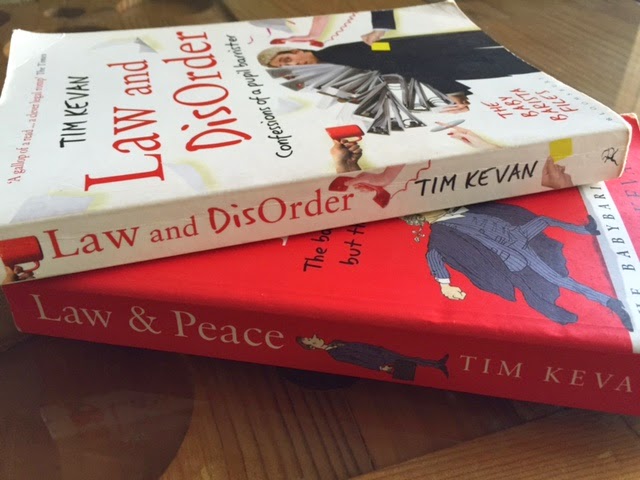
Law and DisOrder  Confessions of a Pupil Barrister  and Law and Peace  are  written by Tim Kevan who has practised as a barrister for ten years and he first created the persona BabyBarista through a blog that was subsequently turned into the book Law and Order. BabyBarista faces competition  right from  his first day, he has to win ,by foul means or fair, the sought-after prize of a tenancy in chambers.  Law and Peace is the sequel when BabyB has made it and gained tenancy in a proper barristers’ chambers and yet  he is far from “You made it Baby B…You need never worry again.” Both novels are  fictional accounts of a pupil barrister at the English Bar. Since  his pupilage, BabyB encounters unscrupulous lawyers like his first pupil master  and  he also encounters senior lawyers with decency and integrity like the characters, OldRuin and TheBusker. The pupil barrister’s journal is hilarious and there is more than a kernel of truth in the stories.

In the epigraph of To Kill a Mockingbird, Harper Lee quoted Charles Lamb   : “Lawyers, I suppose, were children once.”.
 
Tim Kevan  also quoted Charles Lamb:“Lawyers, I suppose, were children once.”. in the epigraph of Law and DisOrder.

Being a lawyer is not an easy job. If only the general public could appreciate that lawyers were once children too. Hence they are just as human and flawed  as every one else on this planet. We also meet shifty characters, various kinds of individuals, financial institutions and corporations which definitely only have their own interest and profit margin in mind.  We have got to be even handed when dealing with these clients.
Supertrees, Singapore

Tuesday, March 24, 2015

Delicious


Twenty five guests were coming to my place. On the eve of the Chinese New Year dinner party, I went shopping at the grocers nearby for additional sets of spoons and forks. There are three grocer stores  within less than fifteen minutes drive from where I reside. Amongst the limited selections at these grocer stores, I had to make a snap decision. When I was at one of the stores, as I skimmed through quickly the section where the cutleries were  displayed,  a young boy around eleven years old stood in front of the section where ice cream scoops were placed and  he turned to  his parents who were with him.

“What’s the matter?”  asked the mother of the boy. 

“ It is so hard to scoop the ice cream with a spoon . We should get one of these.”

“ Don’t eat then,” his mother responded. 


At home , after taking the ice cream tub out from the freezer,  I usually leave the  ice cream out for a few minutes. Not only it makes it easier to scoop out chunks of ice cream, I find that I  can taste its flavour and texture better. I wonder if the mother would subsequently explain to  the child that if you leave the ice cream out for a little while, it would be easier to dish out the ice cream.

Years ago, when I first read Garlic and Sapphires, I enjoyed Ruth Reichl’s food writing so much that I had to get  Tender at the Bone and Comfort Me with Apples. When I read that Reichl was going to try her hand at fiction, I awaited the publication with much anticipation and when I eventually got hold of the novel, Delicious, I was delighted. I then realized that I have bought too many books that I wanted to get through so I was  no longer  enthusiastic about stories which centre around food. I  enjoy reading memoirs and that is probably the primary reason that  I find Ruth’s earlier books engaging and  delightfully delicious.

Reichl’s debut novel is a fiction about Billie Breslin who has traveled to New York to take up a job at Delicious, the most iconic food magazine in New York but the publication is abruptly shut down soon after she has started working. While the colourful staff at Delicious have to move on to other jobs, Billie has been retained  to uphold the “Delicious Guarantee” – a public relations hotline for complaints and recipe inquiries. When she stays behind in the magazine’s deserted downtown mansion office, she stumbles upon  a secret room hidden  in the magazine’s library where she discovers the letters of Lulu Swan, a twelve year old who wrote to the legendary chef James Beard during World War II. When she first interviews for the  position at the food magazine, she is asked to cook for the editor and that  sends her into a full- blown panic attack. She then makes a real impression with her amazing gingerbread, its recipe is provided  by Ruth Reichl at the end of the novel. Billy is one of those gifted foodie who is described to have the perfect palate but due to some issues of her own, she has lost her urge to cook.
 
   “ Taste this.” Thursday thrust a large wooden spoon into my mouth. Her eyes watches closely as I swallowed. She has fed me a fluffy cloud, no more than pure texture, but as it evaporated it left a trail of flavor in its wake.
   “ Lemon peel,” I said, “Parmesan, saffron, spinach.” She held out another spoonful, and this time, at the very end, I tasted just a touch …something lemony but neither lemon or verbena. It had a faint cinnamon tinge . “ Curry leaf!”
     “ I’m impressed.” Her hands were on her slim hips and her voice was – what? Sarcastic?  “ But I didn’t mean it as a test. I just wanted to see if I’m getting anywhere with this new gnocchi.”
     “That’s an amazing combination. The saffron’s brilliant – it gives it such a sunny flavor. But what made you use curry leaf ? I never would have thought of that .”
      “  It kind of came to me at the last minute. So you think it works?”
       “  Yes ! But maybe you should use a little more?”


Through her prose, Reichl once again conveys the pleasure and  comforts of food and how in the face of darkness and loss, food can make life endlessly delicious even when the going gets tough.  Is that why there are so many food reality television shows going on that makes food seem like such a complicated subject?  Delicious is a food novel that depicts food adventure as  magical and it tells a story about  how food can connect people and help Billie and Lulu  heal their  pains and confront  their  past. Ruth Reichl’s  passion for food is infectious. 


Friday, February 27, 2015

The Invisible


There is a whole pile of fictions that I want to read in 2015 and I have not been able to read as fast as I like. I alternate between fictions that are fun read and those novels that are insightful or soulful . Finally I got around to reading The Trial written by Franz Kafka . The copy  I have at home is translated by Douglas Scott and Chris Waller and it is decades old. After flipping  the pages and getting through the book, re-reading some pages back and forth, the book is presently looking tattered.


 After his death, Kafka bequeathed a number of manuscripts to his friend, Max Brod, with the instruction that they were to be destroyed. Brod disregarded his instruction and thus Der Prozess – translated as The Trial was published a year after he died, about ten years since it was written.

From the beginning of the story, Kafka  sets the tone of his writing in a fashion that makes you feel the bleakness and doom  particularly with regards to the legal process. The mood suggests oppression. In The Trial the representatives of the law are somehow described as functionaries who follow orders in a robotic manner and fulfil their duties without understanding or attempting to understand the Law.  It is apparent from the story that the execution of the legal process was perfunctory and inexplicable. 

Although the book was written around 1914, the parable is relevant even in the present era where we cannot guarantee that the  rule of law is understood in  the only way it must be interpreted and applied.  In the story, on his thirtieth birthday, Josef K, the protagonist  is  arrested and it is never disclosed to him nor the readers the crime that he has committed . He is a bank clerk who is steadily achieving  success in his career path and he  comes across as confident and arrogant. However as the story progresses, he finds himself getting distracted and his work at the bank is terribly affected. Upon hearing about his arrest, his uncle from the country insists that he seeks legal representation and introduces him to his old lawyer friend,  Herr Huld who is on sick bed when K and his uncle visits the latter. Strangely enough, the chief clerk of the court happens to be visiting Herr Huld when K and his uncle calls on him. K becomes frustrated with the lawyer who has been conveying all the information about the tangled workings of the court and K gradually grows weary of his lawyer’s endless talk and seemingly minimal action. In the meantime, it has become common place that people come to know about K’s arrest and one of his bank clients suggests that he contacts a painter who paints portraits for the court. K takes client’s advice and contacts Titorelli the official Court painter who provides him with more information about the Court and the painter offers to use his connections to aid K’s cause.  The painter has inherited the connection from his father and he claims that his position unassailable. He also tells K that the Court is impervious to proof that is brought before it.

 
Titorelli had pulled his chair up nearer the bed and went on in a subdued voice:
‘ I ought to have started by asking you what kind acquittal you want. There are three possibilities, namely actual acquittal, apparent acquittal, and postponement. Actual acquittal is , naturally , the best, the only thing is I haven’t the slightest influence on that kind of verdict. In my opinion there isn’t a single person who could influence a verdict of actual acquittal. The deciding factor there is probably the innocence of the accused. As you’re innocent, it really might be possible for you to rely solely on your innocence. But then you wouldn’t need help either from me or anybody else.’
K was nonplussed at first by this neat exposition ,but then he said just as quietly as the painter :
‘ I think you ‘re contradicting yourself.’
‘How?’ Titorelli asked patiently, leaning back with a smile.

K points out to Titorelli the inconsistencies  one of which is that earlier on the latter has indicated that the judges were open to personal persuasion then he denies by saying that an actual acquittal can never be achieved by personal persuasion. In Chapter  9 entitled ‘In the Cathedral’ K meets the priest who is supposed to be the prison chaplain and is thus connected to the court.
‘ Don’t delude yourself,’ said the priest.
‘How am I supposed to be deluding myself?’ K asked.
‘You’re deluding yourself about the Court,’ the priest said. ‘ In the writings which preface the Law it says about this delusion: before the Law stands a door-keeper. A man from the country comes up to this door-keeper and begs for admission to the Law. But the door-keeper tells him that he cannot grant him admission now. The man ponders this and then asks if he will be allowed to enter later. “Possibly, “ the door-keeper says, “but not now.”

The priest tells the tale to K about the man from the country who has been denied admission to the court despite making use of everything he has, however valuable, to bribe the door-keeper who accepts it all and as he takes each thing, the door-keeper says :
“I am only accepting this so that you won’t believe you have left something untried.”

When he is dying, the man from the country is told by the door-keeper  that the door was intended only for him.

‘The door-keeper realizes that the man is nearing his end and that his hearing is fading, and in order to make himself heard he bellows at the man:
“ No one else could gain admission here, because this door was intended only for you, I shall now go and close it.” 

K and the priest engage themselves in discussing several possible interpretations of the tale.

The priest explains,
“ ……First and foremost, a free man is superior to one who is bound. Now the man from the country is actually free, he can go wherever he wants, it is  only entry to the Law that is forbidden him, and then only by one individual, the door-keeper. If he sits on a stool beside the door and stays there for the rest of his life, this is a voluntary action ,the story says nothing about compulsion. The door- keeper, on the other hand is duty-bound to stay at his post, he may not go out into the country, nor apparently is he allowed to go into the interior of the Law, even if he wanted to. What is more, he is, it’s true, in the service of the Law, yet he serves only this entrance, and therefore only this man, for whom alone this entrance is intended. For this reason, too,he is subordinate to the man. ……”

When K says that he does not agree with the priest’s  point of view as he does not think everything the door-keeper says is true.

“No” the priest replied,’ one doesn’t have to accept everything as true, one only has to accept it as necessary’
“ What a gloomy point of view, “ K said. “The lie has become the order of the world.”

While The Trial is full of symbolisms and surrealism, there is the ring of truth about the relationship between the citizen and the Law and definitely about  human conditions in general that suggests corruption, vileness and misuse of power.